Robots

Our robots

One entry per season, newest first. Each is the final version we actually competed with, plus what mattered most in hardware and in code.

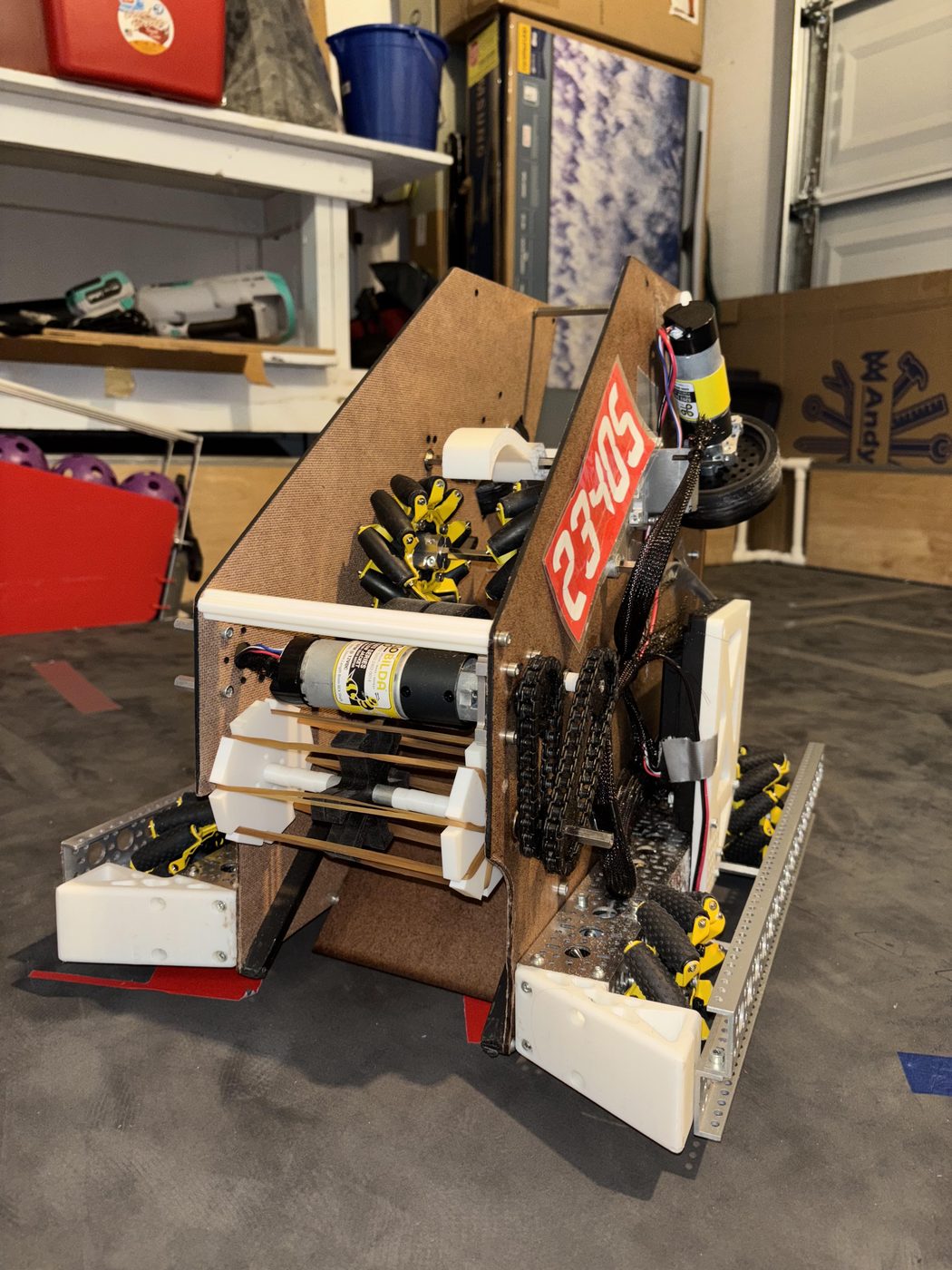
The DECODE 2025-26 robot: a wooden-panelled chassis with a double flywheel shooter, rubber-band intake and a ramp, marked 23405.
DECODE 2025–26 — final Interleague configuration
2025–26 season

DECODE 2025–26

🥉 3rd Place Inspire Award · Feynman League Tournament

We started the season shooting from close range with no indexing. We chose to challenge ourselves and pursue the far launch zone instead — to offer differentiated value and create real synergy with our alliance partners.

Mechanical highlights

  • Double-flywheel shooter on a ramp with an added lip, which fixed our launch angle and made far-zone shots consistent.
  • Rubber-band intake with a curved funnel that holds three artifacts and stops them slipping back out.
  • Crescent transfer on a positional servo, whose geometry acts as a physical hardstop so only one artifact reaches the shooter at a time.
  • Chain-driven drivetrain after bevel gears kept separating under load.

Software highlights

  • Limelight 3A auto-aim — PIDF on robot heading drives AprilTag error to zero, so drivers stop burning seconds lining up.
  • Velocity PIDF + low-pass filter to hold flywheel RPM steady as each artifact passes through.
  • Kalman filter fusion of goBILDA Pinpoint odometry with field AprilTag poses, correcting drift over a 2.5-minute match.
  • Pedro Pathing autonomous and field-centric TeleOp, built on NextFTC commands.
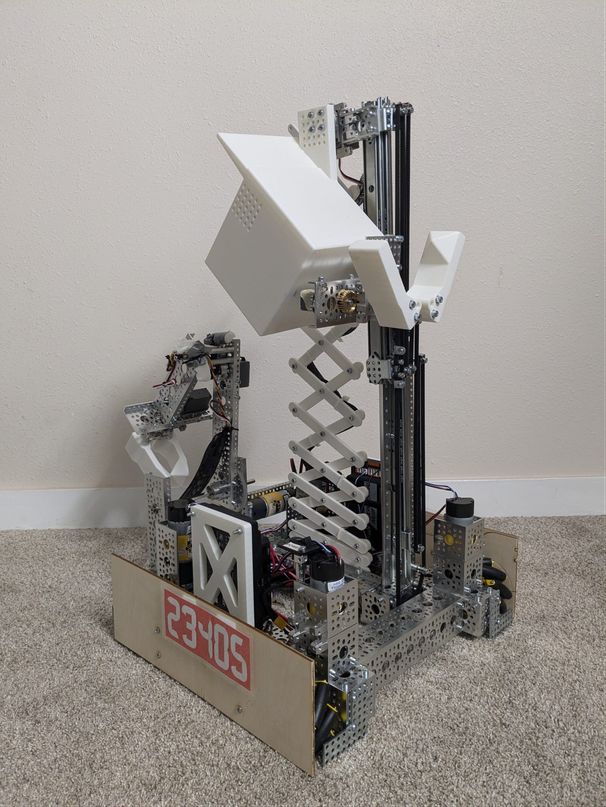
The INTO THE DEEP 2024-25 robot: a scissor lift with a white basket, a linear slide tower and a pyramid claw, marked 23405.
INTO THE DEEP 2024–25 — final Semifinals configuration
2024–25 season

INTO THE DEEP 2024–25

🥇 1st Place Connect · 🥈 2nd Place Connect

We set out to be a versatile alliance partner able to score both samples and specimens, then specialised in specimens for differentiated value once we saw how many teams were strong on samples. The final robot scored a consistent 11–12 specimens per match across auto and TeleOp.

Mechanical highlights

  • Scissor lift for the basket, which made wiring routing dramatically cleaner than a tower alone.
  • Pyramid claw shaped to match the game element, 3D printed and driven by a servo gear train on linear slides.
  • Narrowed, slanted claw so it could take a sample out of a crowded submersible without fouling its other jaw.
  • Longer intake U-channel and a faster linear-slide motor to extend reach and cut cycle time.

Software highlights

  • Custom PIDF with cosine feedforward, giving the arm more power at angles where gravity fights it.
  • goBILDA Pinpoint odometry (deadwheels + IMU) for reliable localization in autonomous.
  • Road Runner trajectories with tuned velocity, visualised in MeepMeep so we could path without the field.
  • Field-centric drive using the Control Hub IMU, plus FTC Dashboard for live tuning.

Method

How we engineer

The same five steps produce every robot we build.

  1. 1

    Define

    Nail down the intended function and outcome so we can plan against it.

  2. 2

    Brainstorm

    Sketch several ideas and name the early risks — jamming, misalignment — before any prototype exists.

  3. 3

    CAD

    Build it in Onshape and 3D print it. Software ideas get prototyped in code.

  4. 4

    Build & test

    Assemble from the CAD, then record performance and results rather than trusting a feel.

  5. 5

    Iterate

    Analyze, then redesign or keep. This loop is what produced the crescent transfer.

Our code on GitHub